
An AI platform applied to proteins should not be limited to generating sequences: it should help select which candidates are worth advancing, under which criteria, and with what experimental hypothesis.
Designing proteins is not just about generating more sequences
Artificial intelligence has dramatically expanded our ability to explore new protein sequences. Today, it is possible to propose variants, redesign specific regions, and open search spaces that only a few years ago would have been difficult to explore systematically.
However, in real protein development, generating possibilities is not the end of the problem. Often, it is only the beginning. A design process may propose hundreds or thousands of potential variants and still leave open the most important question: which ones are worth advancing toward experimental validation.
That decision rarely depends on a single property. A protein may show good activity and, at the same time, present problems related to stability, aggregation, expression, solubility, potential immunogenicity, or manufacturability. The opposite can also happen: a technically robust variant may lose part of the function that made it interesting.
For this reason, at InsAIght we understand AI applied to proteins not as a sequence factory, but as a way to connect generation, evaluation, and experimental decision-making. The goal is not to produce more candidates, but to help select more effectively which ones make sense for the project.
The real challenge: many variants, many properties, and few obvious decisions
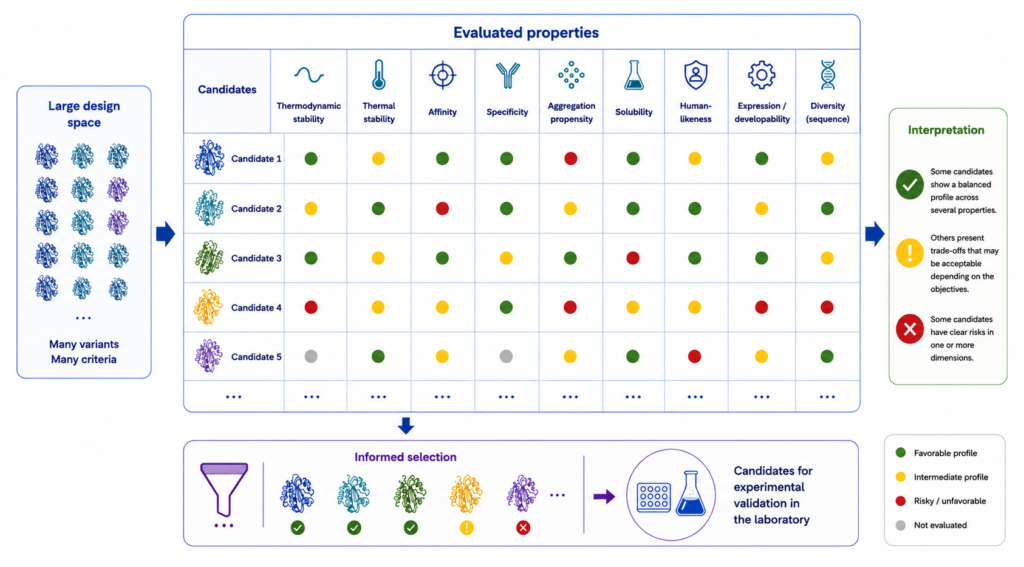
During a protein engineering campaign, the decision space grows quickly. A team may start from a parental protein with promising activity, but with room for improvement in stability, affinity, specificity, developability, or behavior under use conditions.
From there, variants can be proposed through rational design, mutagenesis, directed evolution, computational design, or combinations of these approaches. Each of those variants can be evaluated against several criteria, and not all of them push in the same direction.
The practical difficulty is not only measuring properties. It is interpreting trade-offs. One variant may improve one metric and worsen another. A set of candidates may look promising, but be too redundant. A design may satisfy sequence constraints, but move away from the real conditions of formulation or process.
When this happens, reducing the decision to a single score can be misleading. What is needed is an integrated reading: which candidates are technically reasonable, which present clear risks, which should be discarded, and which are worth taking to the laboratory first.
The logic of the InsAIght platform: generate, evaluate, and prioritize
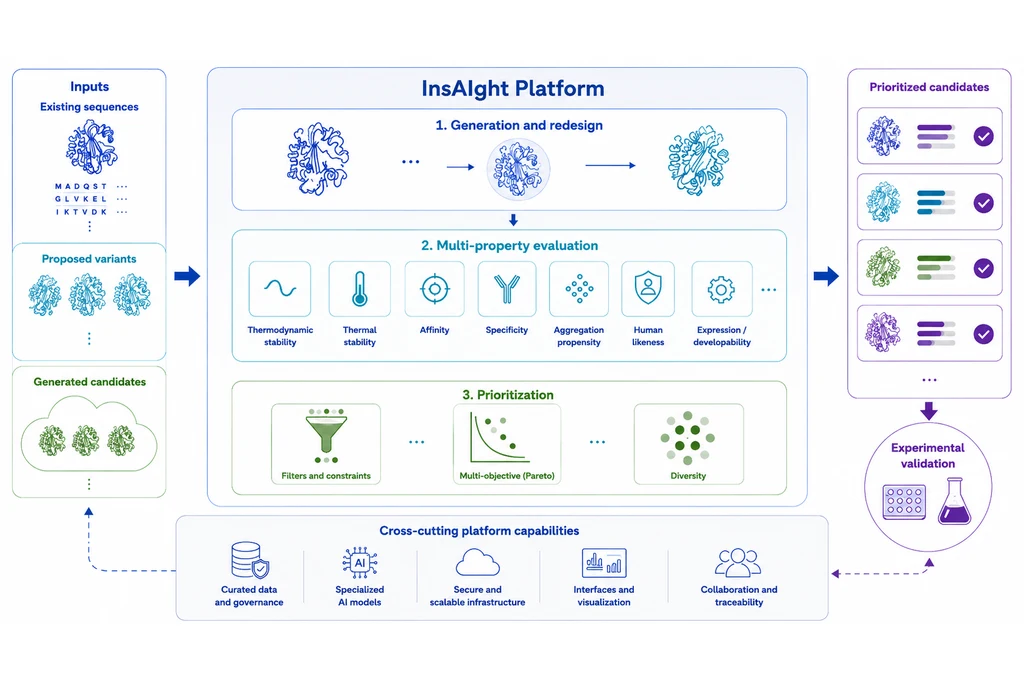
The InsAIght platform is designed to work precisely at that intermediate point between the computational space and the experimental decision. Its function is to help transform a broad set of possibilities into a reasoned list of candidates.
The workflow can be understood in three layers. The first is sequence generation or redesign. At this stage, StructureGPT makes it possible to propose variants or redesign proteins using structural information, regions of interest, and project-specific constraints.
The second layer is multi-property evaluation. Candidates are not analyzed from only one dimension, but through several relevant signals: thermodynamic stability, thermal stability, affinity, specificity, aggregation propensity, human-likeness, or other developability properties depending on the case.
The third layer is prioritization. This is where hard constraints, multi-objective analysis, diversity criteria, and expert review come into play. This part is essential: scoring candidates is not enough; it is necessary to build a shortlist that makes experimental sense.
Taken together, the platform makes it possible to move from generating or collecting many alternatives to selecting a group of candidates that can be defended both technically and experimentally.
Multi-property evaluation: why a single signal is not enough
In protein development, optimizing a single property is rarely sufficient. A candidate sequence may be attractive because of its function, but unsuitable because of its stability. Another may have a more favorable stability profile, but lose affinity. Another may look interesting in one metric, but add little diversity compared with the other candidates in the series.
That is why multi-property evaluation is a central part of the platform. Models and criteria such as ΔGSeq, ThermoSeq, HumanSeq, AffinitySeq, and other modules make it possible to observe different dimensions of the same candidate set. The intention is not for each module to decide separately, but for their signals to be integrated in support of a more complete decision.
This integration changes how results are interpreted. Instead of simply asking which variant has the best value in one metric, the platform makes it meaningful to ask which set of variants best balances function, stability, developability risk, and experimental value.
The difference may seem subtle, but it matters. In a real campaign, the goal is not to find the perfect candidate in a table, but to select a reasonable set of hypotheses worth testing in the laboratory.
From computational results to candidates for validation
A useful platform does not end with the generation of a long list of predictions. It should help turn those predictions into a design decision.
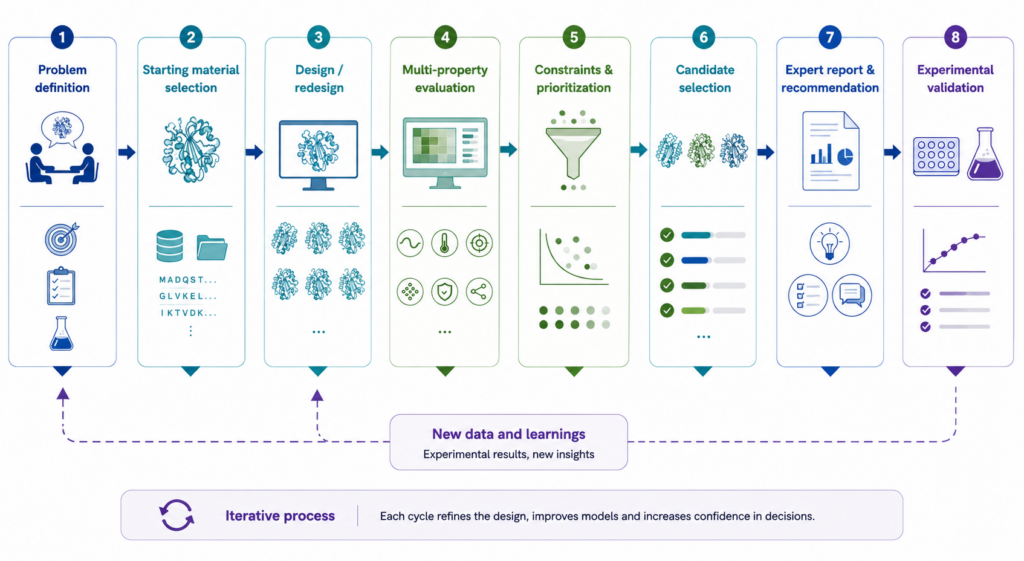
In a typical project, the work starts by defining the problem: which protein is to be improved, which properties are critical, which constraints cannot be violated, and what type of experimental validation is planned. From there, the structures, sequences, and criteria that will guide the design are selected.
The platform can then generate or redesign candidates, evaluate them against several properties, and apply filters or prioritization criteria. The result should not be an opaque list of scores, but an interpretable shortlist: candidates selected for concrete reasons, with associated advantages, risks, and recommendations.
This makes it possible to reach the laboratory with clearer hypotheses. Not all experiments have the same informational value, and not all candidates justify the same effort. The platform helps decide where to start.
Prioritization: constraints, Pareto, and diversity
Prioritization should not be understood as automatically choosing the candidate with the highest value in one column. In many projects, the best decisions are made by combining three types of criteria.
The first is constraints. Some conditions are simply mandatory: preserving a region, avoiding certain changes, maintaining a functional motif, respecting length limits, or excluding candidates with clearly undesirable properties.
The second is multi-objective optimization. When several properties matter at the same time, Pareto-type analysis helps identify candidates that offer reasonable trade-offs, instead of pursuing an isolated improvement that may come at a cost in other dimensions.
The third is diversity. If several candidates are almost equivalent to one another, it does not always make sense to take all of them to the laboratory. A useful shortlist should explore distinct alternatives, not simply repeat very similar variants.
This combination of constraints, multi-objective analysis, and diversity makes it possible to build more robust candidate lists. It does not eliminate experimental uncertainty, but it helps manage that uncertainty more intelligently.
What clients gain from working with an integrated platform
For a client, the value of an integrated platform is not access to an isolated model, but a more useful technical recommendation to advance the project.
This may include prioritized candidates, comparison between variants, identification of trade-offs, property maps or rankings, justification of applied filters, and recommendations for experimental validation. In some cases, the result will be a shortlist of variants. In others, it may be a redesign strategy, a risk assessment, or a proposal for initial experiments.
The difference is that each decision is connected to the project objective. It is not about saying that a sequence is good or bad in the abstract, but about explaining why it is worth advancing, what uncertainty remains, and which experiment would help resolve it.
This way of working is especially relevant for therapeutic proteins, antibodies, industrial enzymes, and biomolecules with demanding requirements for function and developability. In all these cases, selecting better at the beginning can save time, reduce poorly informed exploration, and improve the quality of experimental decisions.
Scope, limits, and experimental validation
The InsAIght platform should be understood as a technology for prioritization and expert support, not as a substitute for experimental validation. Computational predictions are useful when they are well defined, interpreted within the appropriate domain, and connected to concrete decisions.
Each module has its own scope. A prediction of stability, affinity, or human-likeness does not, by itself, exhaust the complexity of a protein. For this reason, results must be interpreted together and with scientific judgment.
When a project moves toward critical decisions, experimental validation remains essential. The role of the platform is to reach that stage with better candidates, better questions, and a clearer reading of the risks.
In this sense, a well-defined limit does not weaken the platform; it makes it more useful. Knowing what each module can contribute, and what it cannot, is part of making responsible decisions in protein development.
From more possibilities to better decisions
AI applied to proteins should not be measured only by the number of sequences it can generate. In real development, value appears when those possibilities become decisions: what to design, what to evaluate, what to discard, what to validate, and how to learn from the result.
InsAIght integrates generation, evaluation, and prioritization to help move through that path. The platform makes it possible to work with broad design spaces without losing sight of the constraints, properties, and experimental decisions that determine candidate viability.
This is not about replacing the laboratory, but about reaching it with a more focused strategy. Nor is it about trusting a single prediction, but about combining signals, criteria, and experience to select candidates with stronger technical rationale.
If you are exploring protein variants, multi-property optimization, or experimental prioritization strategies, contact us. At InsAIght, we can help you assess how our platform may fit into your project.