
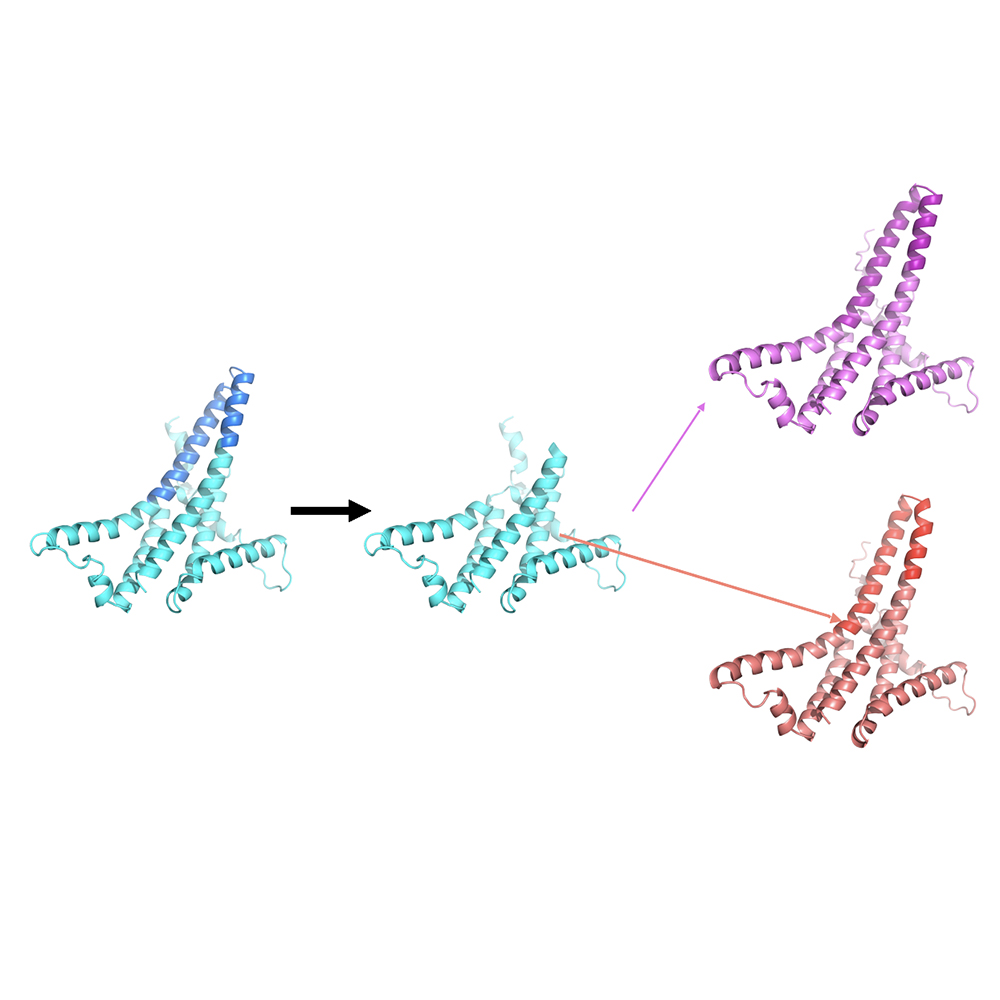
1. Structure prediction models
Many AI tools focus on predicting protein structures from amino acid sequences. These models, such as AlphaFold and similar technologies, have revolutionized our ability to understand how a given sequence folds into its functional three-dimensional structure. These models are incredibly powerful for basic research and have significantly advanced our understanding of protein biology.
Comparison with InsAIght’s Platform: While structure prediction is vital, our platform offers the reverse capability—translating protein structure into sequence. This is particularly valuable for protein engineering and optimization tasks, as it allows us to design sequences that achieve specific structural and functional outcomes. Additionally, our platform goes beyond prediction, incorporating property prediction models that ensure the designed proteins meet production and functionality requirements.
2. Sequence generation models
Transformer-based models for protein sequence generation have gained attention in recent years. These tools generate novel protein sequences by learning from existing sequence data, and they are used to explore new protein functionalities or to generate variants with improved properties. Such models are widely used in research but may lack the integration needed for industrial applications.
While our platform also includes a sequence generation model (StructureGPT), it stands out by integrating this capability with property prediction and experimental validation. This comprehensive approach ensures that the generated sequences are not only novel but also practical for real-world applications. Additionally, our inpainting functionality allows for targeted protein design, filling gaps or redesigning specific sections of proteins, which adds flexibility for more innovative tasks.
3. Property prediction tools
A number of AI tools are designed to predict specific properties of proteins, such as binding affinity, stability, or solubility. These tools are essential for understanding how a protein might behave in a biological system, and they are often used to guide protein engineering efforts. However, many of these tools are highly specialized, focusing on a single property at a time.
InsAIght’s platform is differentiated by its holistic approach to property prediction. Our XSeq models predict multiple properties simultaneously, allowing for the optimization of stability, solubility, aggregation, expressibility, and more. This multi-property optimization is particularly important for industrial applications where balancing various factors is key to successful protein production and deployment.
4. Integrated platforms for industrial application
There are few AI platforms that integrate sequence generation, property prediction, and validation into a single workflow tailored for industrial use. Most platforms are either research-focused or address only one aspect of the protein design process, such as sequence generation or property prediction.
InsAIght’s platform stands out as an end-to-end solution, encompassing sequence generation, property prediction, and experimental validation. This integration ensures that our designed proteins are ready for industrial-scale production or innovation, saving time and reducing costs for our clients. By managing the entire workflow, we can ensure that the proteins we deliver meet both functional and production-related criteria.
InsAIght’s competitive edge
What truly sets our platform apart is its versatility and focus on practical applications. While many AI-driven protein design tools are groundbreaking in their own right, they often cater more to academic research than to real-world industrial needs. At InsAIght, we’ve built our platform specifically for the biopharmaceutical and biotechnology industries, offering solutions that optimize proteins for production and manufacturing or create highly innovative, patentable proteins. Our ability to combine generativity, inpainting, property prediction, and experimental validation gives us a competitive edge in delivering proteins that are not only well-designed but also ready for implementation in industrial processes.